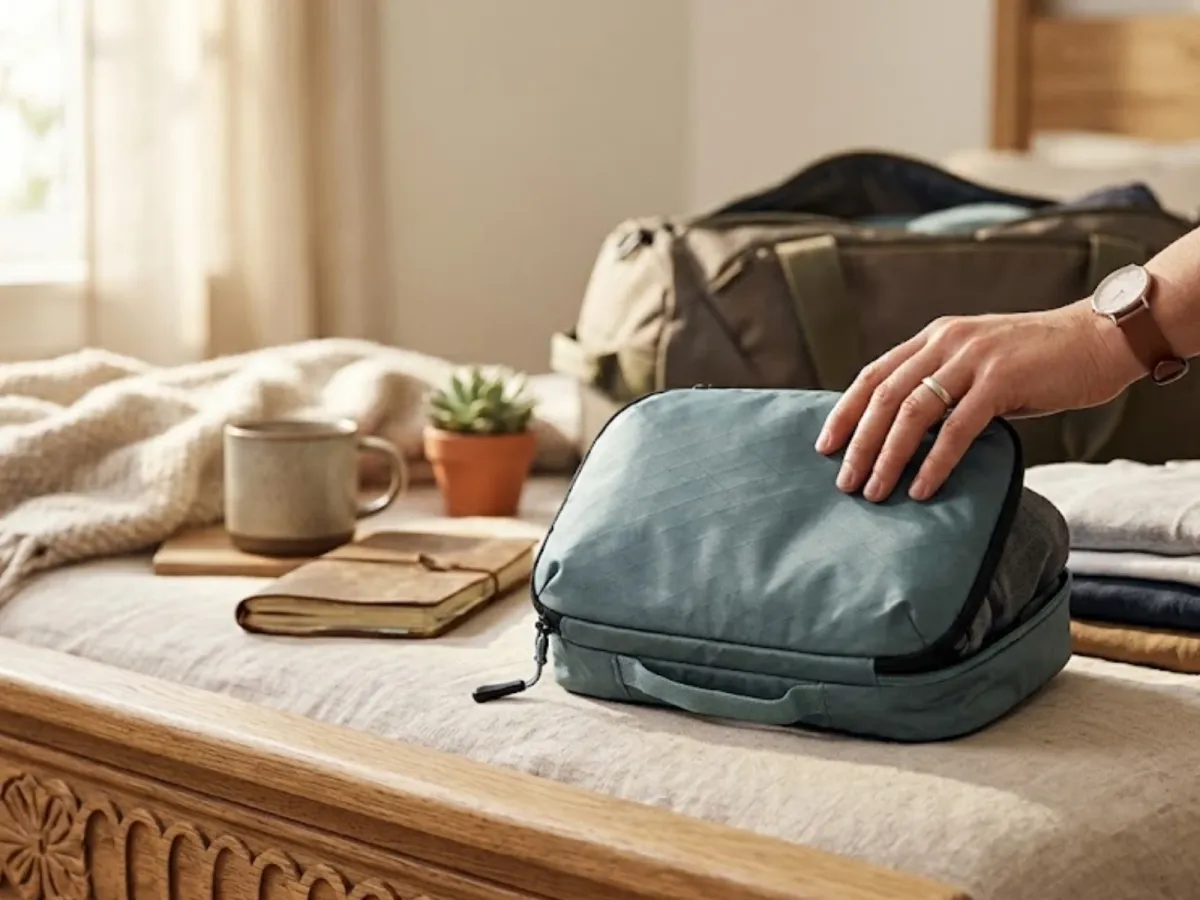
Regular packing cubes keep clothes organized. Compression cubes do that too, with a separate zipper that draws the packed cube together. Choose a regular cube if you mainly want tidy clothing groups; consider compression if you want another way to manage a bulky bundle.
The right choice depends on your bag and packing habits. If your carry-on already closes comfortably, keeping what you have is a perfectly good option.
Product comparisons at a glance
| Product | Type | Best for | Key features | Main trade-off |
|---|---|---|---|---|
| Eagle Creek Pack-It Reveal Cube Set (XS/S/M) | Regular (set of three) | Sorting clothing into groups of different sizes that stay easy to identify | Three sizes in one set; mesh tops; angled openings for stacked or rolled clothes | No compression zipper; three cubes may be more than you need |
| Eagle Creek Pack-It Isolate Compression Cube S | Compression | A shallower packing area, with accessory weight in mind | Listed 3-inch standard height; 54 g; 70D ocean-recycled nylon | Extra zipper step; plan fit around the standard size, not the compressed height alone |
| Thule Compression Packing Cube Small | Compression | A deeper compartment and a preference for ripstop nylon and YKK zippers | Listed 4.3-inch expanded height; 100D ripstop nylon; YKK zippers | Taller expanded shape needs more vertical room than the Eagle Creek options |
Scroll sideways if needed to compare all five columns.
Eagle Creek Pack-It Reveal Cube Set (XS/S/M)
Type: Regular (set of three)
Best for: Sorting clothing into groups of different sizes that stay easy to identify.
Pros
- Three sizes—XS, S, and M—for small items, tops, and bulkier pieces.
- See what’s inside through the mesh tops.
Cons
- No compression zipper; three cubes may be more than you need, and the Medium has a listed 14 × 10-inch footprint.
Eagle Creek Pack-It Isolate Compression Cube S
Type: Compression
Best for: A shallower packing area, with accessory weight in mind.
Pros
- A listed 3-inch standard height to consider for a shallower compartment.
- A listed 54 g empty weight to factor into your packing list; made with 70D ocean-recycled nylon.
Cons
- Adds a zipper step; plan fit around the standard size, not the listed 1-inch compressed height alone.
Thule Compression Packing Cube Small
Type: Compression
Best for: A deeper compartment and a preference for ripstop nylon and YKK zippers.
Pros
- A taller expanded shape for a different layout in a deeper packing area.
- 100D ripstop nylon and YKK zippers if those components are on your buying checklist.
Cons
- The listed 4.3-inch expanded height needs more vertical room; plan fit around that size, not the compressed height alone.
A closer look at the three options
Eagle Creek Pack-It Reveal Cube Set (XS/S/M)
Starting from scratch, or want to sort a whole trip’s clothing rather than add a single cube? This three-piece set gives you an extra-small, a small, and a medium regular cube. Each has a mesh top that gives you a view inside and an angled zippered opening. Consider it when organization is the goal and you would rather skip an extra compression step.
Who it’s best for: Travelers who want to divide clothing into groups of different sizes—small items, tops, and bulkier pieces, for example—and see the contents without opening every cube.
Key features
- Three regular cubes: one XS, one S, and one M.
- Mesh tops and angled zippered openings.
- Listed dimensions for the two larger cubes: S 10 × 7 × 3 inches; M 14 × 10 × 3 inches.
- Recycled 300D polyester and poly mesh construction.
Pros
- Three sizes let you keep small items, tops, and bulkier pieces in separate groups.
- See what’s inside each cube through its mesh top, with no extra compression zipper to close.
Cons
- No separate zipper to draw a bulky clothing group together.
- You are buying three cubes; if you need only one size, a single cube is the simpler purchase.
Before buying: This is a three-piece set, so plan space for each cube you intend to pack. The Medium’s listed 14 × 10-inch footprint takes up more of a carry-on compartment than the Small’s. Check that the listing is for the regular Reveal set rather than a Reveal compression model, and match each cube’s dimensions to the compartment you plan to use.
View on Amazon — Eagle Creek Pack-It Reveal Cube Set (opens in a new tab)
Eagle Creek Pack-It Isolate Compression Cube S
Want to try zipper compression in a shallower packing area? Start by comparing the Isolate Compression S with your compartment. Its listed 3-inch standard height is shorter than Thule’s expanded profile, and its 54-gram empty weight is useful to know if you keep a close eye on packing accessories. The ocean-recycled nylon is another reason to consider it if recycled materials matter to you.
Who it’s best for: Travelers who want a compression cube with a shorter standard profile, or who consider empty weight and recycled materials when choosing packing accessories.
Key features
- Separate opening and compression zippers; translucent 70D ocean-recycled nylon.
- Listed standard dimensions: 10 × 7 × 3 inches; weight: 1.9 oz / 54 g.
- Manufacturer-listed compressed dimensions: 10 × 7 × 1 inch.
Pros
- A listed 3-inch standard height to consider for a shallower compartment.
- A listed 54 g empty weight to factor into your packing list; made with 70D ocean-recycled nylon.
Cons
- Closing the compression zipper adds another packing step.
- A filled cube may need more room than its listed 1-inch compressed height; use the standard size to plan fit.
Before buying: Check that the single Small is selected; the same listing can also offer Medium cubes and multi-cube sets. The specifications here are Eagle Creek’s published figures, and a retailer’s listing may show different numbers. Compare the standard dimensions with your compartment and neighboring items. Its outer measurements match the Small cube in the Reveal set, but avoid assuming the two will hold the same clothing load. If you already own the cube, check the fit with the clothes you plan to bring.
View on Amazon — Eagle Creek Pack-It Isolate Compression Cube S (opens in a new tab)
Thule Compression Packing Cube Small
Have a deeper compartment to work with? Thule’s Small cube offers a taller expanded shape to consider: 4.3 inches, compared with the Isolate Compression Cube S’s listed 3 inches. It is a candidate for travelers who want zipper compression in that format and prefer 100D ripstop nylon and YKK zippers.
Who it’s best for: Travelers with room for the taller expanded shape who have ripstop nylon and YKK zippers on their buying checklist.
Key features
- Separate compression zipper; translucent 100D ripstop nylon; YKK zippers.
- Listed expanded dimensions: 10.2 × 7.1 × 4.3 inches; weight: 0.18 lb.
- Manufacturer-listed compressed dimensions: 10 × 7 × 1.25 inches.
Pros
- A taller expanded shape for a different layout in a deeper packing area.
- 100D ripstop nylon and YKK zippers if those components are on your buying checklist.
Cons
- Its listed 4.3-inch expanded height needs more vertical room than the Eagle Creek options, making it a less natural starting point for a shallow compartment.
- A filled cube may need more room than its listed 1.25-inch compressed height; use the expanded size to plan fit.
Before buying: Check that the single Small is selected; the same listing can also offer Medium cubes, sets, and multipacks. Measure your compartment’s usable depth, and treat this cube as a different size from Eagle Creek’s Small cubes, even though they share a Small label.
View on Amazon — Thule Compression Packing Cube Small (opens in a new tab)
Buying guide: choose around the way you pack
Regular vs. compression packing cubes: what’s the difference?
A regular cube’s main job is organization. It gives a clothing group its own container—useful whether you separate shirts from underwear or keep an outfit together.
A zipper-compression cube adds a separate zipper around its sides. After closing the opening, you close that second zipper to draw the cube together. Two pulls on a single opening zipper are not the same thing as two independent zipper tracks.
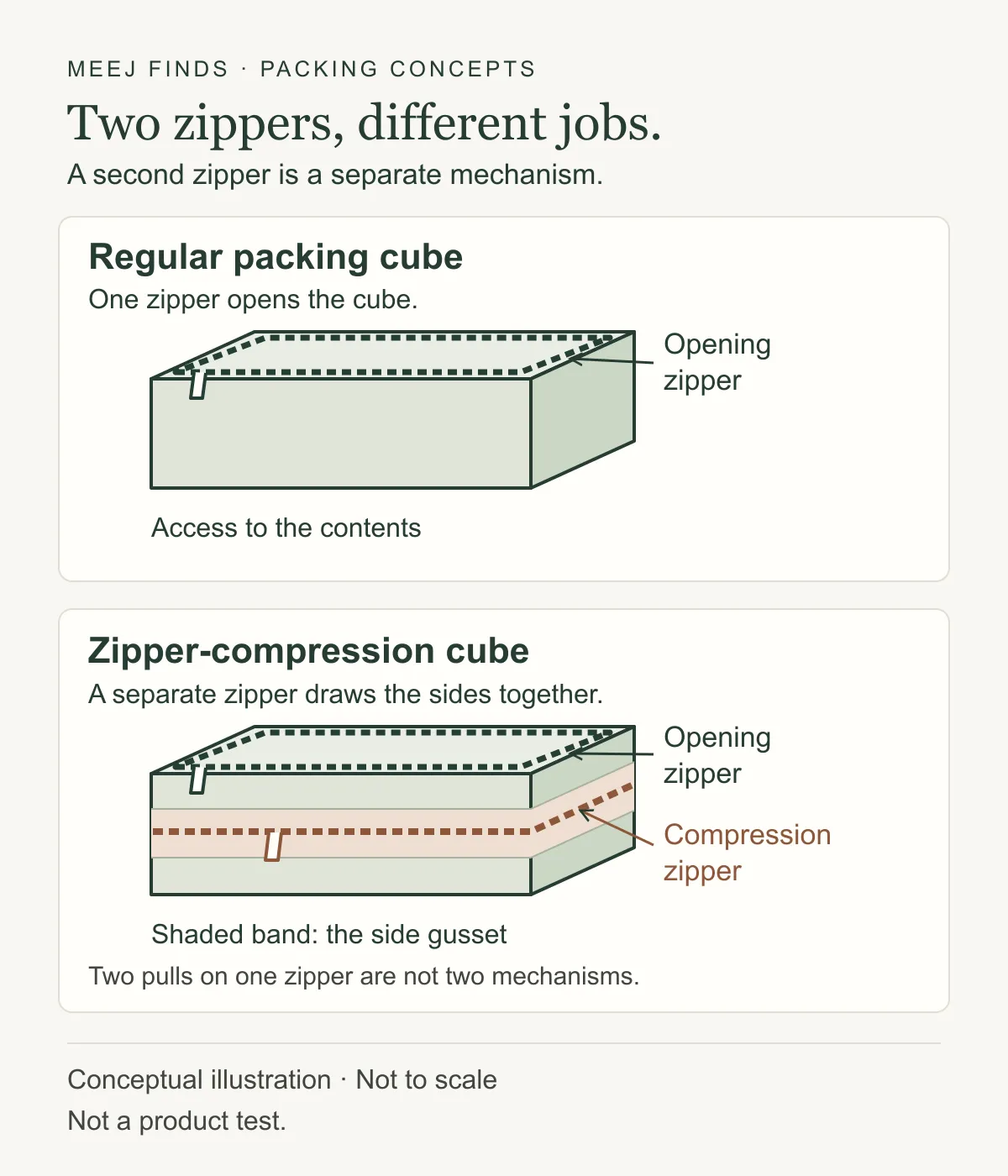
Conceptual illustration — not to scale; not a product test. The drawing shows general zipper functions, not the appearance of an Eagle Creek or Thule product.
This comparison covers fabric cubes with a separate compression zipper. Vacuum bags are a different product type and are outside its scope.
When is a compression cube worth considering?
Start with a specific problem. If one clothing group feels bulky and you want to try drawing it together, a compression cube may be worth considering. If you mainly want to locate clothes and keep them separated, a regular cube already addresses that need.
Think about access, too. A separate compression zipper is another step to manage when you pack. Consider how often you expect to reopen and repack that clothing group.
You can mix the two types. Keep a regular cube for a group you expect to open frequently, and consider a compression cube for clothing that can stay packed. There is no need to replace every cube or buy a complete set to explore that arrangement.
How to choose the right cube size
Shop by dimensions, not Small or Medium labels. Those labels are not shared capacity standards, and the three options here do not all have the same expanded dimensions.
For a compression cube, use its standard or expanded dimensions to plan the layout. The manufacturer-listed compressed dimensions describe another state of the cube, rather than a guaranteed shape with your clothes inside. A filled fabric cube can bulge, so consider the whole arrangement instead of adding up tidy rectangles.
Do not turn a listed change in height into a suitcase-space savings percentage. The clothing, packed shape, and gaps around a cube all affect the result.
How to measure the usable space inside your carry-on
The exterior size of a suitcase does not tell you how much room is available in each packing compartment. Work with the space your clothes can actually occupy.
- Choose where the cube will sit. Identify wheel housings, handle channels, lining, and pockets that interrupt that area.
- Measure inside length and width. Check any narrow sections rather than relying only on the longest edges.
- Check usable depth. Account for items underneath, neighboring compartments, and the space needed for the lid to close without force.
- Compare the exact cube’s dimensions. Use standard or expanded measurements as your starting point. If you already own the cube, check it with your intended clothing load.
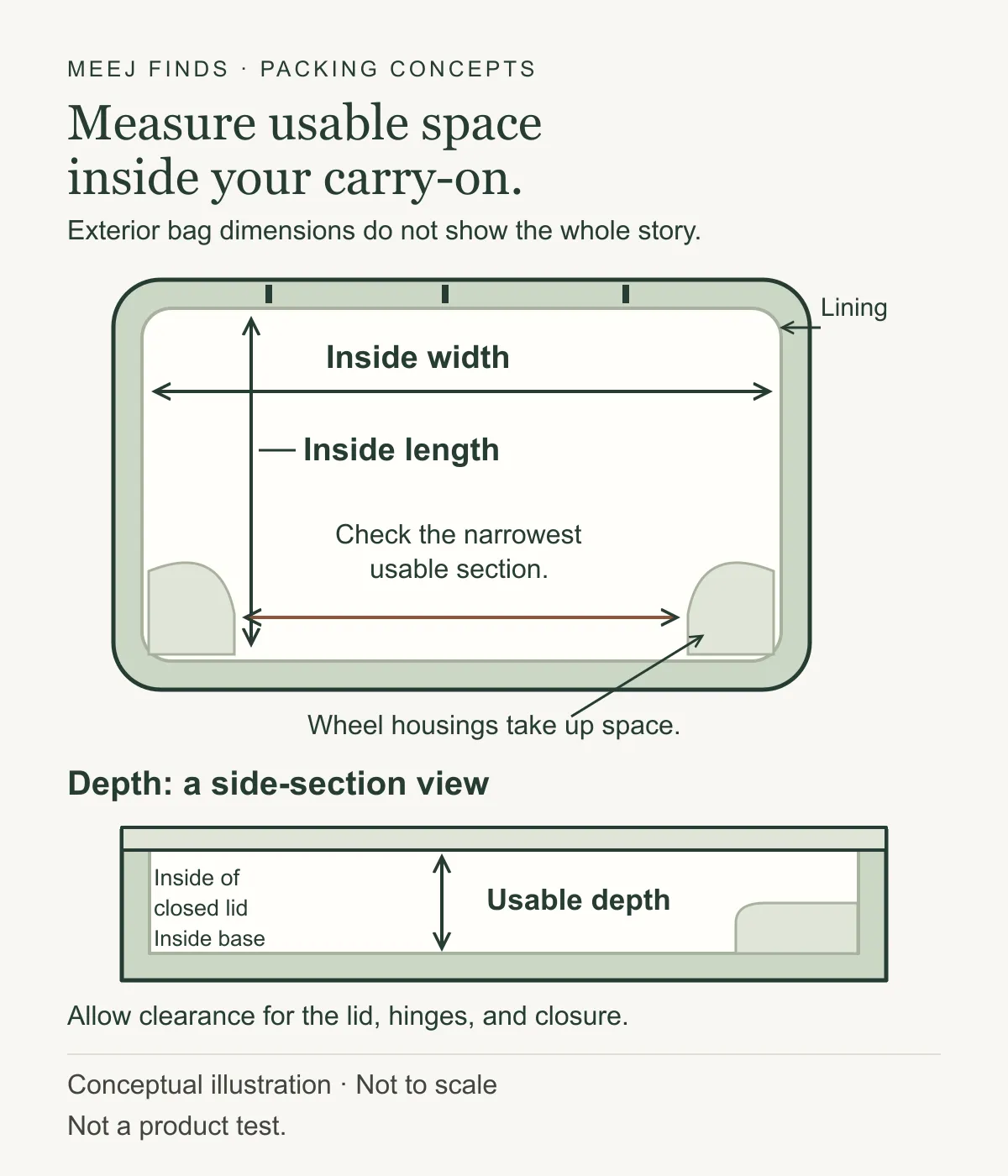
Conceptual illustration — not to scale; not a product test. Measure your own bag; this drawing does not establish product fit or airline acceptance.
When you may not need to buy new cubes
If your clothes stay organized and the bag closes comfortably, keep your current setup. A different cube should solve an inconvenience you can name, rather than create another purchase on your packing list.
If closing the bag requires force, revisit what you are bringing before buying an organizer. Removing an item may solve the problem; a compression zipper is not a guaranteed fix for an overfilled carry-on.
Frequently asked questions
Are compression packing cubes better than packing cubes?
Compression cubes offer an extra function, rather than a better choice for every traveler. Regular cubes separate clothes into organized groups; zipper-compression cubes also draw a packed group together with a second zipper. The trade-off is another packing step. Compare dimensions and weight alongside that feature, rather than choosing by the word “compression” alone.
Do I really need compression packing cubes?
No—if your clothes stay organized and your carry-on closes comfortably, keep your current setup. Consider buying only when you can name a packing problem you want to address, such as a bulky clothing group. One compression cube alongside your regular cubes may be enough to try that approach; trimming your packing list is another option.
How do I choose packing-cube sizes for my carry-on?
Measure the usable space inside each compartment, including depth and areas interrupted by pockets or hardware. Compare that space with the exact cube’s standard or expanded dimensions—not its size label. Leave room for packed fabric to bulge and for neighboring items. A final check with your actual clothing load is more useful than assuming every Small cube fits alike.
Do compression packing cubes reduce luggage weight?
No. Compressing the same clothes changes their arrangement, not their mass. The cube contributes its own weight, which varies by model and materials. A lighter cube can change the weight of your packing accessories, but the compression mechanism itself does not make your clothing lighter. To reduce the load, reconsider what you bring.
Should I roll or fold clothes in packing cubes?
Either can work. Choose the method that suits the garments and makes them convenient to retrieve. Eagle Creek describes the Reveal cubes’ angled openings as suited to stacking or rolling clothes. Follow garment care instructions and avoid overfilling the cube. Neither method should be treated as a guarantee of wrinkle-free clothing or a fixed amount of space saved.
Sources, research notes & disclosures
We compared the manufacturers’ published features and specifications, last checked on October 13, 2026. The three products are examples, not a tested ranking. Meej Finds has not used or independently tested these cubes, measured compression results, or verified wrinkle prevention or durability. Packed shape and results depend on what you pack and how you use the cube.
The buying guidance is our interpretation of the documented features. Material and zipper specifications describe construction, not a tested quality ranking; a change in listed dimensions is not a measured suitcase-space saving. The two illustrations explain general concepts; they are not product photographs or measurements. The “View on Amazon” links are affiliate links; see the disclosure at the top of this article.
- Eagle Creek Pack-It Reveal Packing Cubes Set (XS/S/M) — set contents, dimensions, materials, and openings.
- Eagle Creek Pack-It Isolate Compression Cube S — dimensions, weight, materials, and compression zipper.
- Eagle Creek packing cubes — explanation of the second compression zipper.
- Thule US Compression Packing Cube Small — specifications and features.
Take what’s useful. Choose what fits.
Back to the journal ↗